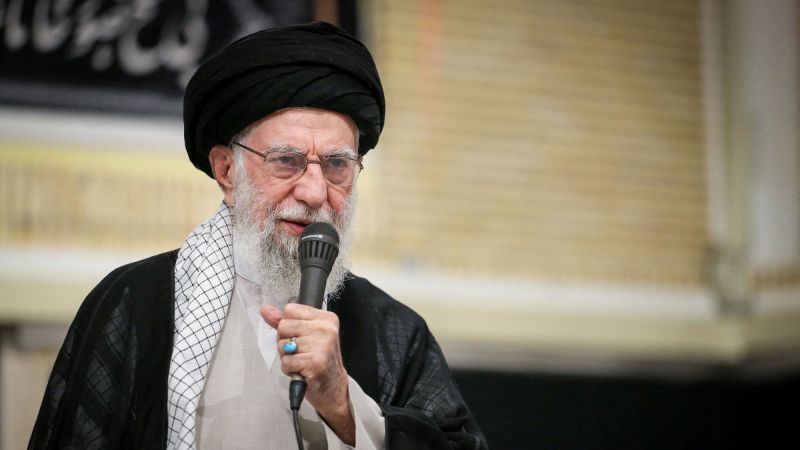
The Middle East has been plunged into an unprecedented era of uncertainty following the confirmed death of Iranian Supreme Leader Ali Khamenei. The veteran cleric, who wielded absolute power for over 36 years, was reportedly killed in a coordinated military operation by the United States and Israel. This seismic event has ignited a frantic succession crisis within Iran and sent shockwaves across the globe, with immediate implications for regional stability and international power dynamics. President Donald Trump, celebrating the outcome, has lauded the intelligence operation and pledged continued military action, setting a stark tone for what lies ahead for a nation suddenly grappling with the void left by its most powerful figure.
A New Era Dawns: The Aftermath of Khamenei's Demise
Iranian state media has officially confirmed the "martyrdom" of the 86-year-old Supreme Leader Ali Khamenei, acknowledging his death in an Israeli strike that was part of a larger joint military operation with the U.S. This confirmation signals a monumental shift for Iran, a country that has been under Khamenei's authoritarian rule since 1989. For over three and a half decades, he was the ultimate arbiter of all major state policies, from nuclear ambitions to regional proxy wars, shaping the modern Islamic Republic.
President Trump did not mince words in his celebration of the event. He appeared to confirm direct U.S. intelligence involvement, stating that the ayatollah "was unable to avoid our Intelligence and Highly Sophisticated Tracking Systems." This assertion underscores the sophisticated nature of the operation and signals a bold declaration of intent from Washington. The Iranian government has announced 40 days of public mourning, a period traditionally observed for significant national figures, but this period will be anything but quiet as internal and external forces vie for influence.
Khamenei's death is widely perceived as a massive blow to the existing regime, potentially accelerating its collapse—a stated goal of U.S. and Israeli officials behind this audacious operation. His demise marks not just the end of an individual's rule but potentially the beginning of the end for the hardline clerical establishment as it has been known.
Trump's Bold Claims and the Path to "Peace"
President Trump’s reaction to the news of the iran leader dead has been unequivocal. Beyond confirming U.S. involvement, he issued a stern warning that military strikes would "continue, uninterrupted throughout the week or as long as necessary" to achieve what he termed "peace throughout the Middle East and, indeed, the world." This aggressive stance suggests a sustained campaign designed to capitalize on the leadership vacuum and further destabilize the current Iranian system.
Crucially, Trump also made an appeal directly to Iranian security forces and members of the Islamic Revolutionary Guard Corps (IRGC), claiming they were already seeking immunity and urging them to "peacefully merge with the Iranian Patriots." This is a direct call for defection and an attempt to sow discord within the regime's powerful military and intelligence apparatus. The success of such an appeal remains to be seen, but it highlights a multi-faceted strategy aimed at internal fracture.
Analysis: Trump's declarations carry significant weight. On one hand, they could be interpreted as a strategic move to empower internal dissent and weaken the IRGC's resolve by offering an olive branch to those who might consider abandoning the regime. On the other hand, such forceful rhetoric risks provoking a strong nationalist backlash, potentially rallying remaining hardliners against external interference. The coming days will test the effectiveness of this strategy and reveal whether it truly paves a path to regional peace or ignites further conflict. The world watches to see if this aggressive posture is a prelude to broader regional realignments or a dangerous escalation that could spiral out of control.
Decimated Leadership and the Succession Vacuum
Under Iran's constitution, the death of a Supreme Leader triggers a specific succession process: an interim council assumes power while the Assembly of Experts, a body of 88 Islamic clerics, selects a new Supreme Leader. However, the coordinated strikes appear to have thrown this carefully structured process into disarray. Israel claims its initial strikes severely decimated Iran's chain of command, targeting 30 top military and civilian leaders and killing several senior defense and intelligence officials. This unprecedented decapitation strike complicates any smooth transition.
Confirmed killed officials include some of Iran’s most pivotal figures:
- Ali Shamkhani: Khamenei's top security adviser.
- Mohammad Pakpour: Islamic Revolutionary Guard Corps commander.
- Aziz Nasirzadeh: Defense Minister.
- Mohammad Shirazi: Khamenei's chief military secretary.
- Saleh Asadi: Head of Iranian military intelligence.
- Hossein Jabal Amelian: Chairman of the SPND (Iran's nuclear weapons research organization).
- Reza Mozaffari-Nia: Former SPND chairman.
This extensive list of casualties suggests a significant incapacitation of the regime's operational and decision-making capabilities. While Israeli officials targeted Khamenei's sons, including Mojtaba Khamenei—who was widely considered a potential successor—intelligence assessments suggest they survived the strikes. Yet, the loss of so many key figures, particularly those integral to security and intelligence, creates an immense void. For more on the internal power struggles, read Khamenei Dead: US-Israel Strikes Ignite Iran Succession Crisis.
One notable survivor is Ali Larijani, secretary of Iran's supreme national security council and former parliament speaker. As one of Khamenei's closest confidants and now arguably the most senior civilian official still standing, Larijani's role in any transitional government or future leadership struggle will be critical. The decimation of the leadership presents an extraordinary challenge for the Assembly of Experts, which may find itself severely weakened and unable to effectively carry out its constitutional duties.
Contenders for Power: Pahlavi and the Unknown Future
The political vacuum created by the iran leader dead event has immediately brought forward alternative visions for Iran's future. Reza Pahlavi, the son of the last Shah, Mohammad Reza Shah Pahlavi, has swiftly put himself forward as a potential candidate to lead a transition. Operating from the U.S., Pahlavi has long styled himself as a major opposition figure. In an opinion piece for the Washington Post following Khamenei's death, he wrote, "Many Iranians, often despite facing bullets, have called on me to lead this transition. I am in awe of their courage, and I have answered their call."
Pahlavi's proposed path forward is clear: "a new constitution drafted and ratified by referendum, followed by free elections under international oversight. When Iranians vote, the transitional government dissolves." While he doesn't enjoy universal public support among all regime critics, his historical lineage and proactive stance make him a visible and internationally recognized alternative.
Practical Tip: Evaluating Succession Scenarios
As events unfold, several scenarios could emerge:
- IRGC Seizes Control: With much of the civilian and clerical leadership weakened, the IRGC, Iran's most powerful military force, might attempt to consolidate power and establish a military junta to maintain order and the regime's ideological continuity.
- Internal Power Struggle: Remaining key figures like Ali Larijani could attempt to navigate the existing constitutional framework, potentially forming an interim government and pushing for a new Supreme Leader from within the surviving clerical ranks.
- Popular Uprising and Transitional Government: The strikes, coupled with Trump and Netanyahu's calls for popular opening, could spark widespread protests, potentially leading to a popular movement that aligns with figures like Reza Pahlavi to install a transitional, non-clerical government.
- Fragmented Authority: A lack of clear leadership could lead to regional factions gaining more autonomy, particularly if the central government struggles to assert control.
The question of whether the IRGC moves to seize control, or if the strikes create the popular opening called for by Israeli Prime Minister Benjamin Netanyahu and Trump, remains the defining unknown. The competition between figures like Pahlavi, representing a return to a pre-revolutionary, secular monarchy, and internal figures like Larijani, attempting to salvage a version of the Islamic Republic, highlights the deep divisions within and outside Iran. For a deeper dive into the potential leadership, see Who Leads Iran Now? Pahlavi, Larijani Eye Post-Khamenei Power.
Conclusion
The death of Supreme Leader Ali Khamenei, orchestrated by a joint U.S.-Israeli operation, marks an unparalleled moment in modern Middle Eastern history. The iran leader dead headlines signal not merely the end of a long reign but potentially the unravelling of a political system that has defined Iran for over four decades. While President Trump's strong rhetoric suggests a continued push for a new regional order, the immediate future is shrouded in profound uncertainty. The decimation of Iran's leadership, the struggle for succession, and the competing visions for the nation's path forward—from a military takeover to a popular uprising or even a monarchical restoration—all converge to create a highly volatile and unpredictable landscape. The coming weeks and months will be crucial in determining whether this seismic event leads to a more peaceful Middle East or a new era of intensified regional instability.