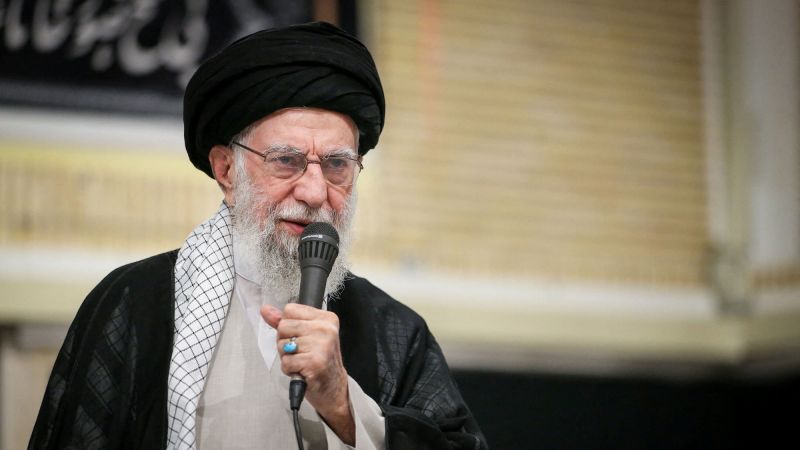
A Nation at the Crossroads: Who Leads Iran After Khamenei's Death?
The sudden and dramatic confirmation of Supreme Leader Ali Khamenei's death, reportedly following targeted US and Israeli strikes, has plunged Iran into an unprecedented leadership vacuum. After more than 36 years at the helm, the passing of such a towering, authoritarian figure immediately sparks a complex succession crisis, sending shockwaves not only through Iran but across the volatile Middle East. The reverberations of an
iran leader dead scenario are already being felt, with key figures both within the regime and from its historical opposition swiftly positioning themselves for what promises to be a tumultuous transition.
Iranian state media confirmed the "martyrdom" of the 86-year-old ayatollah, initiating 40 days of public mourning while simultaneously revealing the devastating impact of the coordinated military operation. US President Trump celebrated the death, asserting that Khamenei "was unable to avoid our Intelligence and Highly Sophisticated Tracking Systems," and warned of continued operations aimed at achieving "peace throughout the Middle East." This external pressure, coupled with the profound internal shock, has set the stage for a critical period where the very future of the Islamic Republic hangs in the balance.
The Unprecedented Power Vacuum After Khamenei's Demise
Khamenei's rule, stretching back to 1989 after the death of Ayatollah Ruhollah Khomeini, cemented his position as one of the world's longest-serving authoritarian rulers. His death represents a massive blow to the existing regime and could indeed accelerate its collapse, a stated goal of both US and Israeli officials. Under Iran's constitution, an interim council comprising the President, Judiciary Chief, and one of the Guardian Council's jurists assumes power, pending the selection of a new Supreme Leader by the Assembly of Experts—a body of 88 Islamic clerics. However, the recent strikes have severely disrupted this traditional process.
Reports from Israeli officials indicate that the opening salvos "decimated the chain of command," targeting approximately 30 top military and civilian leaders and killing at least seven senior defense and intelligence officials. This staggering loss of life among the top brass creates an immediate and profound void. Among those confirmed killed are:
- Khamenei's top security adviser, Ali Shamkhani
- Islamic Revolutionary Guard Corps (IRGC) commander, Mohammad Pakpour
- Defense Minister, Aziz Nasirzadeh
- Khamenei's chief military secretary, Mohammad Shirazi
- Head of Iranian military intelligence, Saleh Asadi
- Chairman of the SPND (Iran's nuclear weapons research organization), Hossein Jabal Amelian
- Former SPND chairman, Reza Mozaffari-Nia
The elimination of such critical figures undermines the very infrastructure of power that would typically manage the succession. This makes the question of who truly wields authority in the immediate aftermath of an
iran leader dead situation exceedingly complex and volatile.
Reza Pahlavi: A Monarchist Resurgence?
Amidst the chaos, a familiar name from Iran's pre-revolutionary past has quickly emerged. From his base in the United States, Reza Pahlavi, the son of Iran's last Shah, Mohammad Reza Shah Pahlavi, has seized the moment to position himself as a potential leader for a transitional government. His father ruled Iran from 1941 until the 1979 Islamic Revolution, and Pahlavi has long styled himself as a significant opposition figure, despite questions about the universal public support he commands among regime critics.
In an opinion piece for the Washington Post following Khamenei's death, Pahlavi wrote, "Many Iranians, often despite facing bullets, have called on me to lead this transition. I am in awe of their courage, and I have answered their call." He outlined a transparent path forward: "a new constitution drafted and ratified by referendum, followed by free elections under international oversight. When Iranians vote, the transitional government dissolves."
Pahlavi's immediate declaration highlights a deep yearning among some segments of the Iranian diaspora and internal dissent for a return to a secular, democratic system, perhaps even a constitutional monarchy. While his proposals offer a vision of a post-Islamic Republic Iran, the challenge lies in translating this diaspora-based aspiration into tangible influence within a deeply entrenched and now violently disrupted power structure. The very idea of a Pahlavi return, however symbolic, signals a profound shift in the political landscape of Iran, inviting a critical look at the broader implications for regime change. For more on the initial impact, see
Khamenei Dead: US-Israel Strikes Ignite Iran Succession Crisis.
Ali Larijani: The Surviving Insider with Influence
In stark contrast to Pahlavi's external challenge, a powerful figure from within the Islamic Republic's establishment has emerged as a crucial player: Ali Larijani. As secretary of Iran's Supreme National Security Council, a former parliament speaker, and one of Khamenei's closest confidants, Larijani is a seasoned politician with deep ties to the clerical establishment. Crucially, he is one of the most senior civilian officials confirmed to have survived the devastating strikes.
Larijani's survival amidst the decimation of so many other high-ranking officials positions him uniquely. He is likely viewed by many within the remaining power structures as a figure capable of maintaining some semblance of order and continuity. His extensive experience in both domestic and foreign policy, coupled with his intricate understanding of the regime's inner workings, could make him a central, perhaps even indispensable, figure in any interim arrangements. Whether he could ultimately ascend to the Supreme Leader position itself, or play a kingmaker role, remains to be seen. However, his continued presence offers a potential internal anchor in what is otherwise a rudderless ship. His background suggests a more pragmatic, perhaps less revolutionary, approach to leadership, potentially appealing to elements within the IRGC and the clerical establishment seeking stability.
Uncertain Futures: IRGC, Popular Uprising, and International Intervention
The true trajectory of Iran in the wake of Khamenei's death remains shrouded in uncertainty. The critical question now is whether the Islamic Revolutionary Guard Corps (IRGC), a powerful and ideologically driven military force, will move to seize control directly, or if the unprecedented strikes will create the "popular opening" that Israeli Prime Minister Benjamin Netanyahu and President Trump have both called for. Trump, in a striking move, urged Iranian security forces and IRGC members to "peacefully merge with the Iranian Patriots," hinting at a desire for internal defection and widespread public dissent.
Intelligence assessments also suggest that Mojtaba Khamenei, one of the Supreme Leader's sons who had been widely discussed as a potential successor, survived the strikes despite being targeted. His potential role, either as a figurehead for a hardline faction or as a means of legitimizing a new leadership through dynastic succession, adds another layer of complexity.
The international community is watching with bated breath. The US threat of continued, "uninterrupted" bombing "throughout the week or as long as necessary" underscores the high stakes involved. This period represents a monumental challenge for international diplomacy, as regional stability hangs precariously in the balance. The profound impact of an
iran leader dead situation on global geopolitics cannot be overstated. For more insights on the broader regional implications, refer to
Iran Leader's Death: Trump Hails Strikes, Middle East Future Uncertain.
Conclusion
The death of Supreme Leader Ali Khamenei has undeniably ushered in a new, profoundly uncertain era for Iran and the Middle East. With the traditional chain of command severely disrupted and key figures eliminated, the path to a new leadership is fraught with peril and unpredictability. While Reza Pahlavi offers a vision from outside the current system, and Ali Larijani navigates the internal power struggles, the ultimate outcome could hinge on the actions of the IRGC, the response of the Iranian populace, and the sustained pressure from international forces. The world waits to see who will ultimately step into the void left by Khamenei, and what form Iran's future will take. The coming weeks and months will undoubtedly be a defining period for a nation at the crossroads, with consequences reverberating far beyond its borders.